Einsum Guide for Attention Pattern
Motivation
- Einsums allows us to more explicitly label what types of computations occur between two tensors in (1) a compact command (2) with labelled shapes
- Helpful for when there's lots of dimensions to handle
- Goal for this document is to go over a generalized formula for how einsums work
Note: I found this youtube tutorial and guide very helpful especially with idioms for using einsums - this document is to summarize the high level algorithm for converting einsums into loops, refer to the docs above for those helpful idioms
Free vs. Sum Indexes
einsm("ij, jk -> ik", A, B) # Matrix multiplication A @ B

# Free Indexes = {i, k}
# Summation Indexes = {j}
- Free Indexes --> Index occurs in the output
- Sum indexes (also called contraction dimensions) --> (~{Free Indexes}), everything that's not a free index
Algorithm for Free vs. Sum Indexes
# Example: einsm("ij, jk -> ik", A, B) # Matrix multiplication A @ B

# Step 1: Declare Indexes
free_indexes = {i,k}
summation_indexes = {j}

# for each index, imagine that the capital (e.g. I) is the size of the dimension

# Step 2: Setup output
ans = torch.zeros([I,K], dtype=torch.float32)
A = ... # Input Tensor 1
B = ... # Input Tensor 2

# Step 3: Free Indexes
for i in range(I):
    for k in range(K):
        # Step 4: Setup an accumulator
        sum_ = 0

        # Step 5: Summation Indexes
        for j in range(J):
            sum_ += A[i,j] * B[j,k]

    # Step 6: Writeout
    ans[i,k] = sum_
Attention Pattern
\[
\text{attention\_pattern} = softmax\frac{QK^\top}{\sqrt d}V
\]
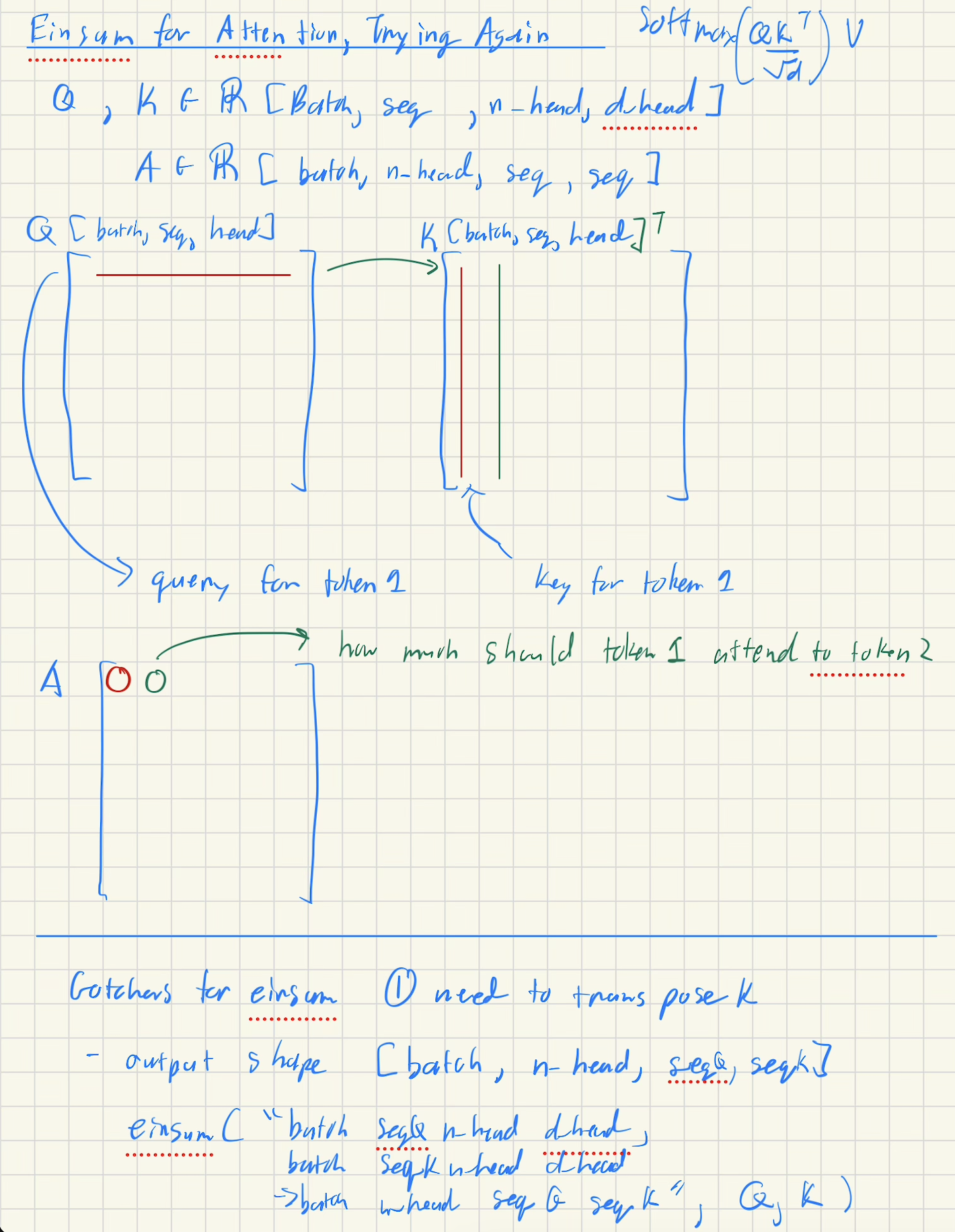
einsum("batch seqQ n_head d_head,
        batch seqK n_head d_head,
    ->  batch n_head seqQ seqK,
        Q, K)

free_indexes = {batch, n_head, seqQ, seqK}
summation_indexes = {d_head}

attn = torch.zeros([batch, n_head, seqQ, seqK], dtype=torch.float32)

for batch in B:
    for n_head in N_HEAD:
        for i in seqQ:
            for j in seqK:
                sum_ = 0

                for c in D_HEAD:
                    sum_ += Q[batch, i, n_head, c] * K[batch, j, n_head, c]
                    # Notice how even thouh we didn't transpose, for each row of Q we go through a row of K which is the same thing as a transpose!
            attn[batch, n_head, i, j] = sum_
- Alternative to
einsumif we were to use good ol' matrix multiplication requiringpermuteandtransposeQ = Q.reshape(batch, seq, self.num_heads, self.d_head) K = K.reshape(batch, seq, self.num_heads, self.d_head) # Permute Q = Q.permute(0,2,1,3) # [batch, num_heads, seqQ, d_head] K = K.permute(0,2,1,3) # [batch, num_heads, seqK, d_head] # Transpose K as in the formula K = K.transpose(-1,-2) # [batch, num_heads, d_head, seqK] """ # [batch, num_heads, d_head, seqQ] free [ batch free num_heads sum d_head free seqK ] """ Q @ K # [batch, num_heads, seqQ, seqK]
Additional Resources
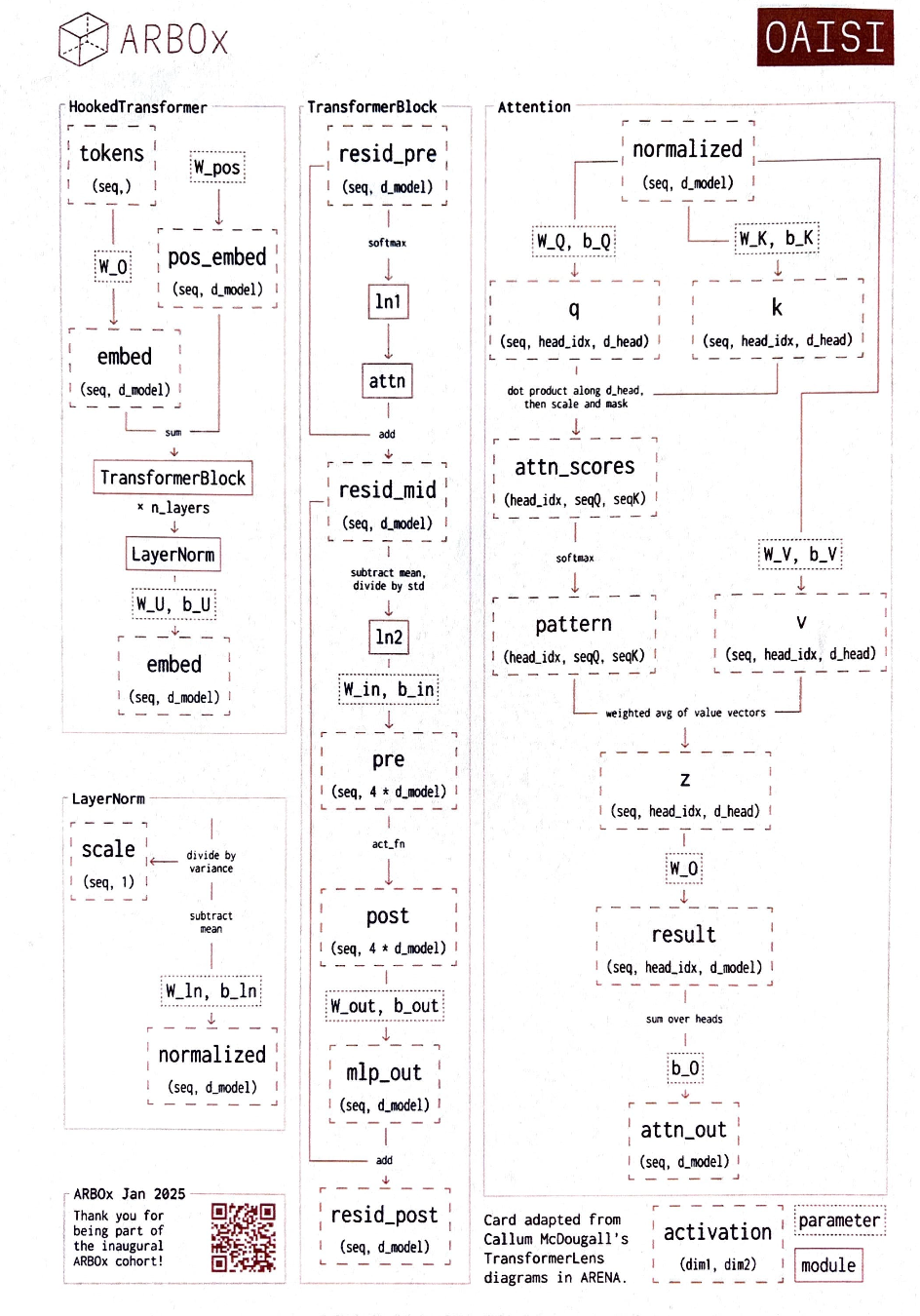
- Transformer lens diagram