Automated Interpretability Agenda
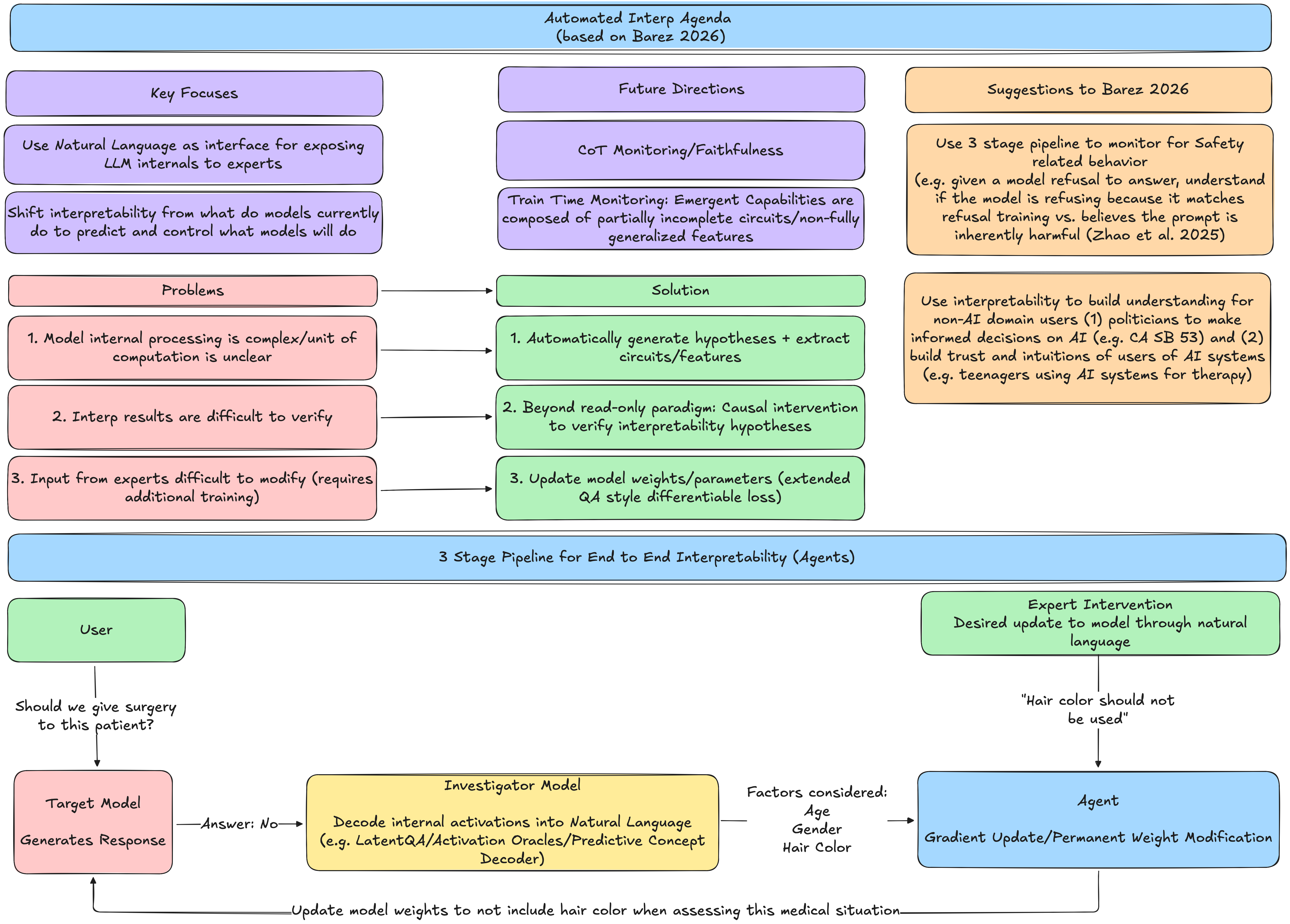
Flowchart and summarization of ideas + 2 ideas for use cases from Fazl Barez's Automated Interpretability Agenda 2026
Original Paper: Automated Interpretability-Driven Model Auditing and Control: A Research Agenda
Thoughts on Automated Interpretability Agenda (Barez 2026)
Response to MATS Summer 2026 application question on an underrated idea in Empirical AI Safety research.
Automated Interpretability has strong promise to catalyze interpretability from a descriptive tool of current model behavior to a robust predictive pipeline to monitor, control, and permanently intervene on increasingly powerful models. The 3-step agentic system in Automated Interpretability-Driven Model Auditing and Control: A Research Agenda [Barez 2026] allows domain experts to interact with
(a) target frontier model,
(b) decode internal activations into natural language via an investigator model a la LatentQA [Pan et al. 2024], Activation Oracles (AO) [Karvonen et al. 2025], Predictive Concept Decoders (PDC) [Huang et al. 2025], and
(c) update model weights to reflect domain expert judgements and verify changes using causal intervention.
I argue that Automated Interpretability agenda is underrated because in addition to pipelines that can monitor CoT faithfulness [Barez et al. 2025] and detect/control emerging model maligned behavior during training with scale (“bitter lesson” style), I also argue that this system can accelerate Safety research racing against soon-to-be agentic Capabilities research while building trust and intuition with non-technical audiences. For example AutoInterp can:
(1) accelerate/verify existing interpretability research such as facilitating end-to-end agent driven causal intervention experiments; step (b) from above could detect whether a model’s harmfulness refusal is using the universal refusal direction [Wang et al. 2025] or an independent harmfulness steering vector [Zhao et al. 2025]
(2) increase literacy of policymakers on current AI Safety practices (e.g. policymakers can independently run causal intervention experiments through a natural language interface) to build intuition/informed decision on AI governance (e.g. California Senate Bill 53) [SB-53]
(3) build trust and intuitions of general users of AI systems (e.g. teens using AI systems for therapy/education can verify underlying reasoning for model responses)
Essentially, Automated Interpretability’s 3-step agentic pipelines have the potential to transform interpretability from a bespoke art, to a scalable science that mitigates x-risk by empowering human engagement and trust of safety in AI systems.
References:
Automated Interpretability-Driven Model Auditing and Control: A Research Agenda [Barez 2026]
LatentQA: Teaching LLMs to Decode Activations Into Natural Language [Pan et al. 2024]
LLMs Encode Harmfulness and Refusal Separately [Zhao et al. 2025]
Refusal Direction is Universal Across Safety-Aligned Languages [Wang et al. 2025]